
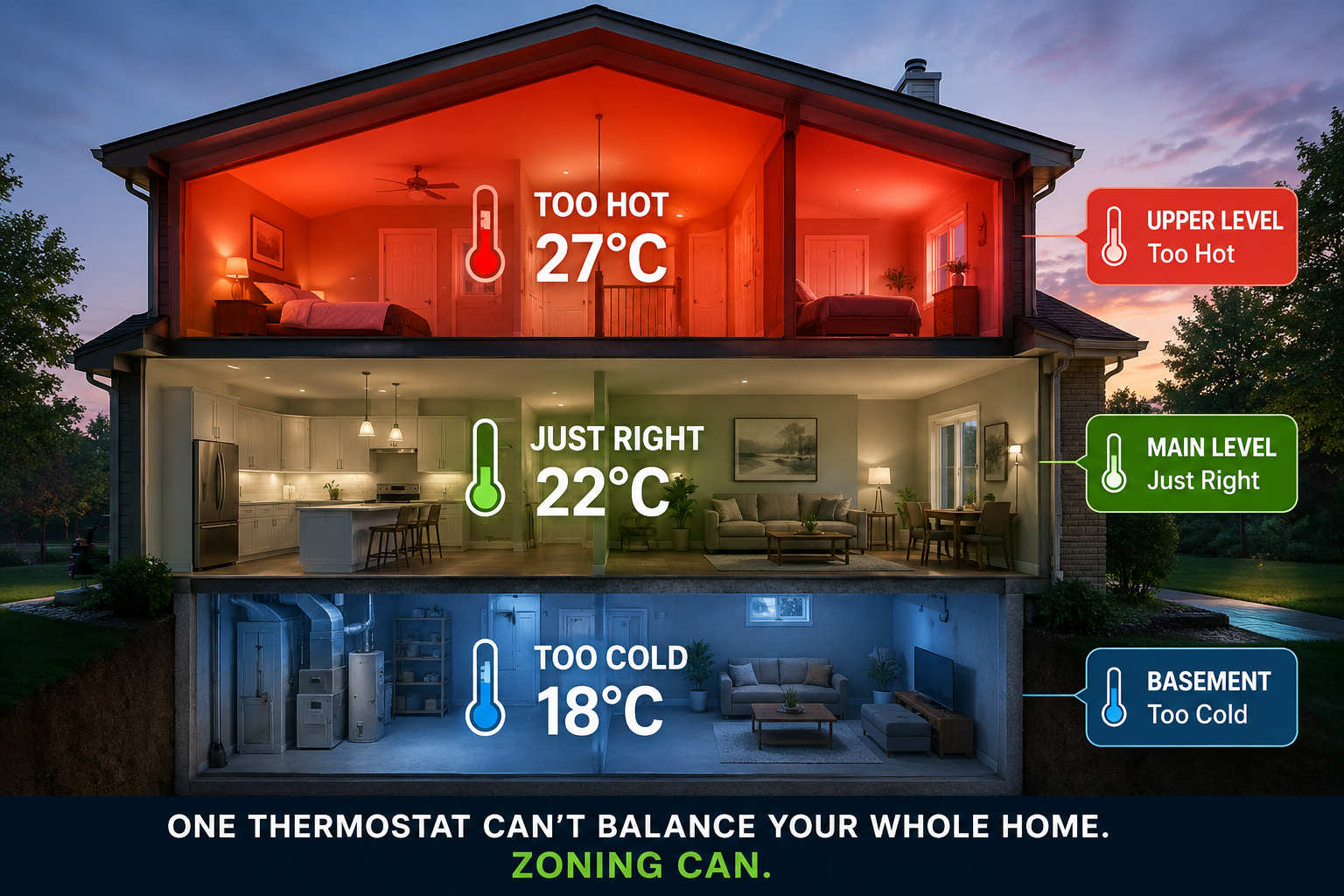
If you are looking into HVAC zoning systems, Ontario two-storey and split-level homes often require these setups to handle severe temperature imbalances. If you live in one of these properties, there’s a good chance you already know the frustrating summer routine.
Bedrooms become stuffy. Kids complain they can’t sleep. Fans start appearing in every room. Someone turns the thermostat down another two degrees, and suddenly the basement feels like a refrigerator while the upstairs still refuses to cool off properly.
The frustrating part is that many homeowners assume this means they need a bigger air conditioner.
In reality, the problem is often airflow, not equipment size.
That’s why more homeowners are exploring HVAC zoning systems Ontario families can use to solve uneven temperatures properly, instead of simply blasting more cold air through the house and hoping for the best.
Your HVAC System Might Not Be Broken, It Might Just Be Fighting Your House
Older homes across Ontario were built very differently than homes today.
A lot of two-storey homes were designed with a single thermostat controlling the entire house. At the time, that was considered normal. The problem is that heat naturally rises, and older duct systems weren’t always designed to distribute airflow evenly between floors.
That means your HVAC system may actually be working exactly the way it was designed to work… while still leaving your upstairs uncomfortable.
Things like sun exposure, attic heat, aging insulation, long duct runs, and poor return airflow all contribute to uneven temperatures. In many cases, the upstairs rooms are simply not getting enough conditioned air to stay comfortable during peak summer heat.
This is where properly designed HVAC zoning systems Ontario homeowners are now investing in can make a dramatic difference.
Instead of treating the whole home like one giant room, zoning allows the system to respond to how the house actually behaves.
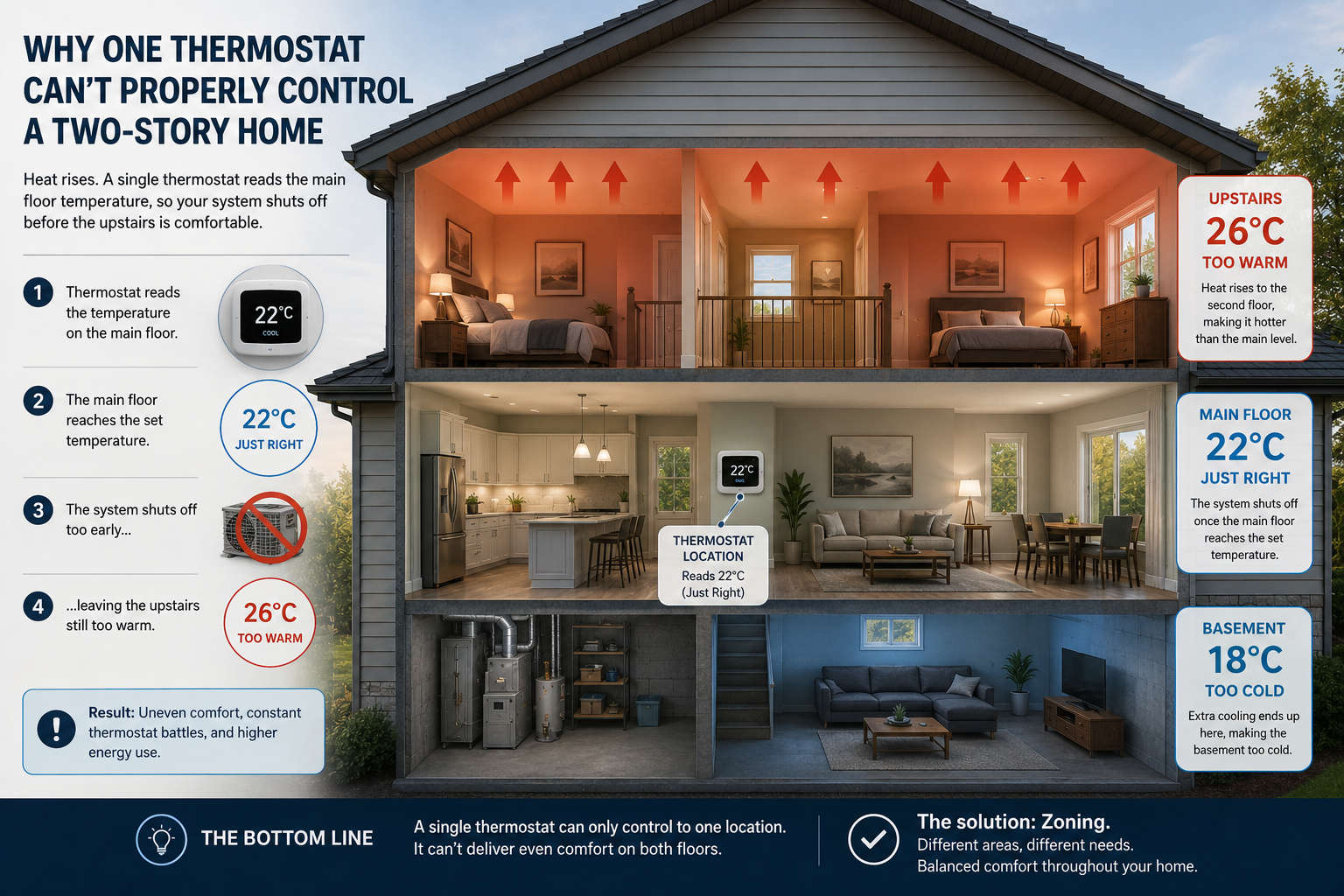
Why One Thermostat Can’t Properly Control a Two-Storey Home
A single thermostat only knows the temperature where it’s installed.
Usually, that thermostat sits somewhere on the main floor, which means the system shuts off once the main level reaches the desired temperature. Meanwhile, the upstairs may still be several degrees warmer.
This is especially common in:
- Older detached homes
- Split-level layouts
- Homes with additions
- Houses with large south-facing windows
- Homes with finished basements
The issue becomes even worse during Ontario heat waves, when upper floors absorb heat all day long.
This is exactly why multi-zone heating and cooling has become so popular. Instead of relying on one thermostat to manage the entire house, zoning creates separate comfort areas throughout the home.
The upstairs can finally get the cooling it needs without overcooling the basement or main floor.
More homeowners looking into smart HVAC Barrie solutions are starting to realize that comfort problems often need smarter airflow strategies, not simply larger equipment.
The Real Solution: HVAC Zoning Systems Ontario Homeowners Are Finally Discovering
When people hear the word “zoning,” they sometimes picture a massive renovation project. In reality, many zoning systems are far more straightforward than homeowners expect.
HVAC zoning systems Ontario contractors install typically use:
- Motorized dampers inside the ductwork
- Multiple thermostats or smart sensors
- A control panel that manages airflow to different areas of the home
The system automatically directs heating or cooling where it’s needed most.
If the upstairs is warmer, the system prioritizes airflow to that area. Once temperatures balance out, airflow adjusts again automatically.
The result is a house that feels more even and more comfortable overall.
For many homeowners, the biggest surprise is how much more comfortable the home feels without constantly adjusting the thermostat.
Properly designed HVAC zoning systems Ontario homeowners choose can also reduce system strain because the equipment isn’t constantly running longer than necessary trying to compensate for uneven airflow.
Fix Hot Upstairs Rooms Without Turning the Basement Into a Freezer
Most homeowners have already tried the temporary fixes.
Closing vents downstairs. Running portable AC units upstairs. Sleeping with fans pointed directly at the bed. Dropping the thermostat lower and lower hoping the upstairs eventually catches up.
The problem is that these fixes usually create new comfort problems elsewhere in the house.
If you want to truly fix hot upstairs rooms, the airflow itself has to be managed properly.
That’s where zoning changes everything.
Instead of flooding the entire home with excess cooling, the system can specifically direct airflow where it’s actually needed. Bedrooms cool faster. Temperatures stay more balanced. The house feels more consistent from floor to floor.
For homeowners trying to fix hot upstairs rooms, this often becomes one of those upgrades where they immediately notice the difference.
And in many cases, it can be done without replacing the entire HVAC system.
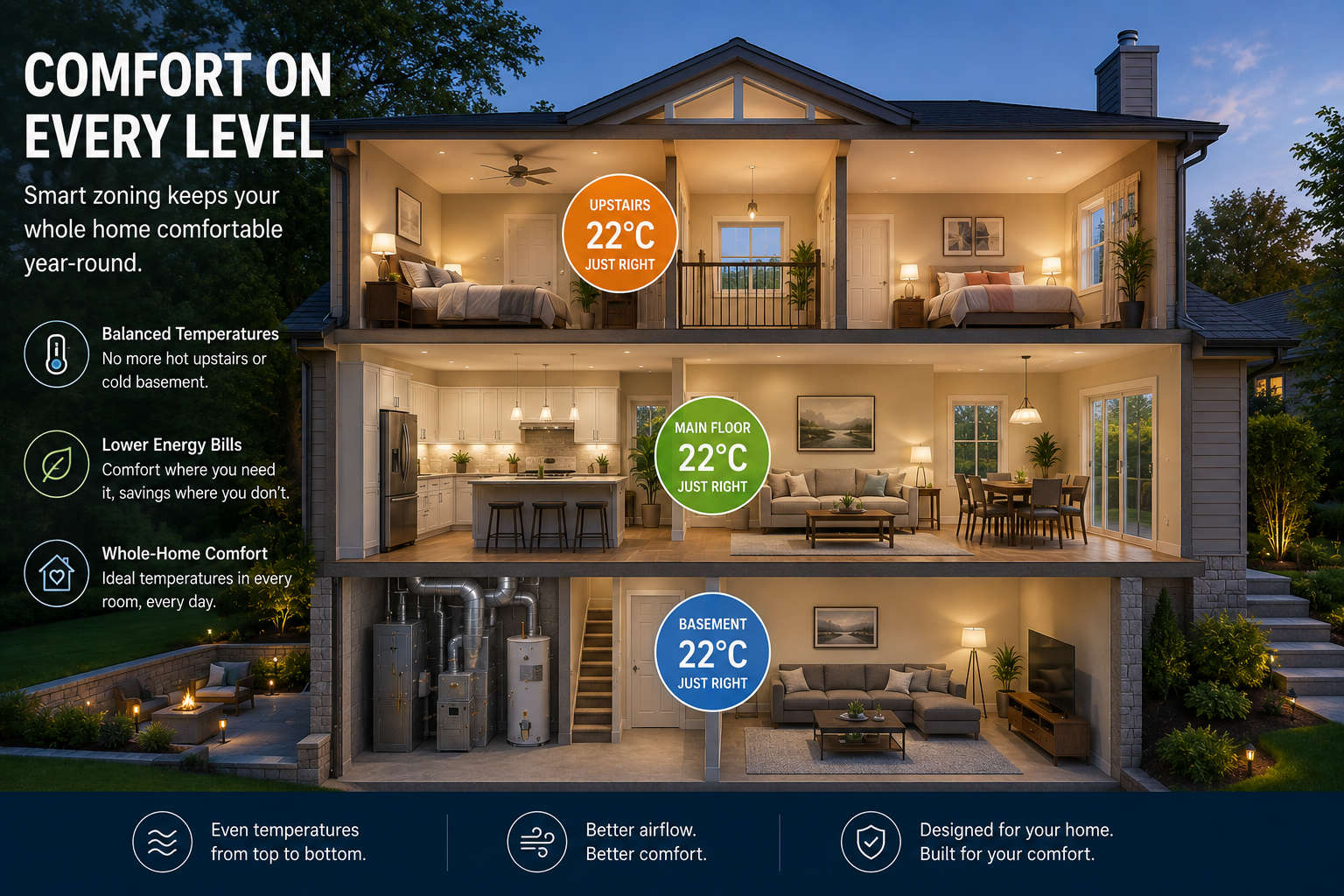
Smart HVAC Barrie Homeowners Are Choosing Comfort Over Thermostat Wars
Modern zoning systems have also become much more user-friendly.
Today’s smart HVAC Barrie homeowners are installing often includes:
- Smart thermostats
- App-based controls
- Room sensors
- Scheduling features
- Automatic temperature balancing
You can adjust temperatures by floor, create schedules for sleeping areas, or prioritize different zones throughout the day.
For example:
- Cooler upstairs bedrooms at night
- Balanced daytime temperatures during work hours
- Reduced cooling in unused areas
The goal isn’t making the system complicated. The goal is making the home feel comfortable without constantly thinking about it.
A properly designed multi-zone heating and cooling setup should quietly solve problems in the background while giving homeowners more control over comfort.
Why HVAC Zoning Systems Ontario Homes Use Don’t Always Require Full Replacement
One of the biggest misconceptions about comfort problems is that they always require brand-new equipment.
Sometimes they do.
But sometimes the issue is:
- Poor airflow balancing
- Undersized return air
- Duct restrictions
- Improper vent placement
- Thermostat location
- Lack of zoning controls
That’s why we approach these issues differently.
Instead of immediately recommending replacement equipment, we look at how the entire house behaves first. In many situations, HVAC zoning systems Ontario homeowners install can work alongside existing equipment and dramatically improve comfort without a full system overhaul.
Sometimes relatively small duct modifications combined with multi-zone heating and cooling controls can completely change how a house feels.
That’s the difference between simply replacing equipment and actually solving comfort problems.
What We Look At Before Recommending a Zoning Solution
No two homes behave exactly the same way.
That’s why diagnosing comfort problems properly matters.
Before recommending HVAC zoning systems Ontario homeowners may benefit from, we look at:
- Existing duct layout
- Airflow restrictions
- Return air design
- Insulation factors
- Room-by-room temperature differences
- Equipment sizing
- Sun exposure
- Home layout and additions
Sometimes the solution involves zoning. Sometimes it involves airflow balancing. Sometimes it’s a combination of both.
The goal is never to oversell equipment. The goal is to solve the actual problem properly.
That calm, practical approach is why many homeowners searching for smart HVAC Barrie solutions end up discovering that the issue isn’t necessarily their furnace or AC unit at all. It’s how the system interacts with the house itself.
The Best Time to Solve Upstairs Heat Problems Is Before Summer Peaks
A lot of homeowners wait until the hottest week of the year before finally addressing uneven temperatures.
By then, the house is uncomfortable, everyone’s frustrated, and the HVAC system is already working overtime.
The truth is, if your upstairs has always been hotter than the rest of the house, that’s usually not something you simply have to live with.
Modern HVAC zoning systems Ontario homeowners are installing can dramatically improve comfort in older homes, especially in two-storey and split-level layouts that were never designed for today’s expectations around temperature consistency. And the earlier these issues are evaluated, the easier it is to prepare before summer heat really settles in.
You Don’t Have to “Just Live With It”
If your upstairs is always hotter than the rest of the house, there’s usually a reason.
And more importantly, there’s usually a solution.
Whether it’s airflow balancing, duct modifications, or properly designed HVAC zoning systems Ontario homeowners can rely on for better comfort, the right approach can completely change how your home feels during the summer.
If you’ve been trying to fix hot upstairs rooms for years, it may be time to stop fighting the thermostat and start looking at the bigger picture.
We can help you figure out what’s actually causing the problem and recommend a practical solution that makes sense for your home.